
Writing Prompt x Reverb: Why Dr. John B. Calhoun Still Matters
Some people in history are underrated because they were ignored.
Others are underrated because we still have not fully understood what they were trying to show us.
Dr. John B. Calhoun falls into that second category for me.
He was an ethologist, a scientist who studied animal behavior, and he became famous — and controversial — for his rodent population experiments. His most haunting work was known as Universe 25, a carefully designed mouse enclosure that was supposed to function like a kind of utopia.
Food was available.
Water was available.
Nesting material was available.
Predators were absent.
Disease was controlled.
Survival, at least on the surface, had been provided for.
And still, the society collapsed.
That is why Calhoun’s work has stayed with me.
Not because humans are mice. We are not. That distinction matters. But because Calhoun’s experiment forces us to ask a deeper question:
What happens when a population has enough to survive, but loses the social structure, purpose, responsibility, and connection required to actually live together?
That is where his work becomes more than a strange animal experiment.
It becomes a mirror.
And honestly, when I look at America right now, I cannot look away.
The Mouse Utopia That Went to Hell
In the Today I Found Out video, Simon Whistler walks viewers through how Calhoun built an environment designed to meet the needs of the mice inside it. The enclosure had food, water, bedding, nesting spaces, and protection from threats. It was not a careless experiment. It was thoughtful. It was built by someone who had already spent years studying rodent populations and social behavior.
Part of what I appreciate about Whistler’s narration is that he does not flatten the story into a simple “mouse apocalypse” tale. The video leaves room for the stranger and more useful question underneath it: why would a population collapse when its obvious needs were being met?
That is part of what makes it so interesting to me.
Calhoun was not just throwing mice into a box to watch chaos happen. Universe 25 was his twenty-fifth version. That alone says something. He was observing, refining, adjusting, and trying to understand what caused collapse when obvious survival needs were met.
At first, the mouse population grew.
Then something changed.
The video explains that in earlier work, Calhoun had created spaces that could physically hold far more rodents than the population ever reached. In one example, the enclosure could have housed thousands of rats, but the population never rose above a much smaller number, even with unlimited food, unlimited water, and no predators. The rodents still crowded together, and that crowding contributed to a breakdown in social behavior.
That detail matters.
The problem was not simply lack of food. It was not simply lack of water. It was not even simply lack of physical space.
Something about the way the animals interacted with the space — and with each other — began to fail.
Calhoun called this phenomenon the behavioral sink.
The phrase itself is chilling. A sink is where things drain. Where energy disappears. Where movement pulls downward.
And in Universe 25, that is what seemed to happen.
Social bonds weakened. Normal roles unraveled. Mothers abandoned or attacked their young. Some males became aggressive. Others became withdrawn. The mice crowded into certain areas while other spaces remained unused. Eventually, reproduction slowed and then stopped.
The colony did not die because the mice were starving.
It died after they lost the ability to function as a society.
Survival Is Not the Same as Society
This is where Calhoun becomes underrated to me.
The easy version of the story is, “A scientist made a mouse utopia and it turned into hell.”
That is interesting enough.
But the deeper version is more uncomfortable:
Calhoun was studying the difference between survival and society.
That distinction matters.
A population can have food and still lose meaning. A population can have shelter and still lose connection. A population can have comfort and still lose purpose. A population can have abundance and still become unstable if the social architecture is broken.
That feels uncomfortably relevant.
America is a country of enormous abundance. Not evenly shared abundance, and that matters. But still, abundance. We have more information, more entertainment, more convenience, more consumer choice, more platforms, more products, more access, and more noise than any generation before us.
And yet so many people are lonely, angry, distrustful, overstimulated, politically exhausted, economically anxious, spiritually restless, and unsure where they truly belong.
We are surrounded by everything.
And still, for many people, it is not enough.
That is the part of Calhoun’s work I cannot stop thinking about.
Not because America is a mouse colony.
But because abundance alone clearly does not save a society.
The Beautiful Ones Were Comfortable, Not Whole
The most haunting part of Universe 25 is not the violence.
It is not even the collapse in reproduction.
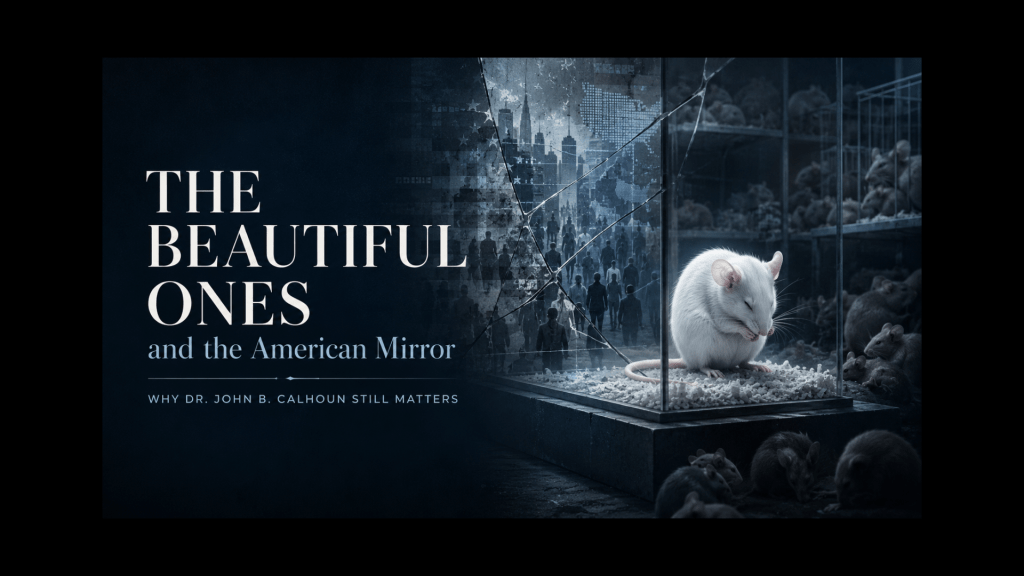
It is the group Calhoun called “the beautiful ones.”
These mice withdrew from the chaos of the colony. They did not fight. They did not mate. They did not nurture. They did not meaningfully participate in the social life around them.
They ate.
They slept.
They groomed.
They stayed physically clean and polished.
On the outside, they looked fine.
That is what makes them so disturbing.
They were not visibly starving. They were not wounded in the obvious way. They were not ragged from fighting.
They were pristine.
And socially dead.
The “beautiful ones” were comfortable, but they were not whole.
They also reveal something uncomfortable about abundance: numbness can become a luxury. In a society fighting for basic survival, everyone is needed. But in a system where the body is fed while the spirit is left idle, people can begin to disappear without physically leaving. They are present, polished, consuming, and safe — but no longer meaningfully connected to the shared world.
That image has stayed with me because it feels like one of the clearest bridges to modern life. Not because grooming, beauty, self-care, or personal peace are bad things. I believe deeply in care. I believe in rest. I believe in healing. I believe in protecting your nervous system when the world becomes too loud.
But there is a difference between healing and disappearing.
There is a difference between self-care and total withdrawal.
There is a difference between protecting your peace and abandoning the shared world entirely.
That is the uncomfortable question the “beautiful ones” raise for me.
What happens when the world feels so chaotic, so aggressive, so rigged, so exhausting, or so meaningless that people retreat into private comfort and call it peace?
What happens when the public world is left mostly to the loudest, angriest, most power-hungry people because everyone else is too tired, too numb, too afraid, or too disillusioned to show up?
That is not a small question.
That is a civic question.
Usefulness Is Neurological Fuel
One of the strongest ideas Calhoun’s work gives us is the need for usefulness.
Not usefulness as exploitation.
Not usefulness as productivity culture.
Not usefulness as the cruel idea that a person only has worth if they are working, producing, earning, or performing.
I mean usefulness in a deeper and more human sense: the feeling that your presence matters, your effort has somewhere meaningful to go, and your participation contributes to something beyond yourself.
Human beings need effort that connects to meaning. We need agency. We need responsibility. We need rhythms. We need social contribution. We need some sense that what we do still matters.
In the video, one detail stood out to me: Whistler explains that some of the male mice, without a reason to defend territory or food because both were plentiful, became dejected. Some formed groups and attacked others seemingly without purpose.
That is haunting.
The energy did not disappear.
It curdled.
And while humans are not mice, I think we should be honest enough to ask what happens when people feel unnecessary inside the systems they are living in.
What happens when work no longer feels meaningful? What happens when politics feels untouchable? What happens when the economy feels rigged? What happens when community feels optional? What happens when digital life gives us constant stimulation but very little true contribution?
A society can give people products, platforms, entertainment, and convenience while still starving them of agency.
And when agency disappears, people do not always become grateful for the comfort around them. Some become numb. Some become angry. Some become tribal. Some withdraw. Some polish the self because the shared world feels beyond repair.
That, to me, is one of the clearest warnings in Calhoun’s work.
The lesson is not that suffering is good.
It is not that scarcity makes people noble.
That would be cruel and far too simple.
The lesson is that living beings need meaningful challenge, useful roles, social connection, and some sense that their effort matters.
Without that, abundance can become hollow.
The Pandemic Did Not Build the Cage, But It Changed How We Lived Inside It
I also cannot think about Calhoun’s work without thinking about COVID.
COVID was not the same kind of experiment. It was a public health crisis, a collective trauma, and a global disruption. People lost loved ones. People lost jobs. People lost health. People lost stability. People lost years of ordinary life that cannot simply be handed back.
But COVID did change how many of us moved through the world.
For a while, distance became care. Avoidance became responsibility. Staying home became participation. Isolation became, in many cases, a moral act.
And then the world reopened.
But people did not always reopen with it.
Some came back more anxious. Some came back angrier. Some came back lonelier. Some came back more suspicious. Some came back more dependent on digital spaces that gave us information, entertainment, and control, but not necessarily belonging.
It is as if many of us lost social muscle during isolation and never fully rebuilt it.
That phrase keeps coming back to me: social muscle.
Because social life requires practice. It requires friction. It requires awkwardness. It requires patience. It requires the part of us capable of reflection, restraint, and nuance to stay stronger than the part of us trained for fear, withdrawal, and defense. It requires ordinary exposure to other people — not as avatars, not as political enemies, not as curated feeds, but as full human beings sharing space.
COVID did not create every fracture in America, but I do think it accelerated some of them. It pushed more of life online. It intensified distrust. It made fear more intimate. It made screens feel like safety. It trained many of us to see other people as potential threats.
Even when the immediate danger shifted, that social conditioning did not simply vanish.
That is where Calhoun’s work starts to echo.
Not as a perfect comparison, but as a warning about what happens when social behavior atrophies.
A society can survive a period of isolation and still struggle with re-entry.
A person can be technically connected and still feel functionally alone.
Digital Nesting Boxes
In Universe 25, one of the strange details was that the rodents often crowded together even when other spaces were available.
That feels familiar in a different way.
Not physically, necessarily.
Digitally.
We have more information than ever before, but we often crowd into ideological corners. We have more ways to communicate than ever before, but many people feel less understood. We have access to a global town square, but instead of building a shared reality, we often retreat into private digital universes.
Algorithms learn what keeps us engaged. Outrage keeps us engaged. Fear keeps us engaged. Identity keeps us engaged. Conflict keeps us engaged.
And slowly, the digital world becomes a kind of nesting box.
A place where we are constantly fed.
Fed information.
Fed entertainment.
Fed validation.
Fed enemies.
Fed reasons to stay exactly where we are.
But being fed is not the same as being nourished.
That may be one of the most important distinctions in this entire piece.
The internet gives us endless “food,” but not all of it makes us well. Sometimes it keeps us huddled in corners, reacting to shadows, defending territory that is not even real.
Sometimes the fight becomes the role.
Sometimes the outrage becomes the proof of belonging.
And that is dangerous for a democracy.
Because democracy requires more than reaction. It requires participation, trust, disagreement without dehumanization, shared reality, and people who still believe the public world is worth tending.
If too many people retreat, the social fabric frays.
If too many people only attack, the social fabric tears.
Either way, the colony weakens.
The Problem Is Not Abundance. The Problem Is Broken Design.
This is where I think we have to be careful with Calhoun.
The shallow takeaway from Universe 25 is that comfort ruins people.
I do not believe that.
People deserve food, shelter, healthcare, safety, rest, and dignity.
The lesson is not that hardship is morally superior.
The lesson is that comfort without meaning does not create wholeness.
And abundance inside a broken system can still become a cage.
That matters when we look at America.
Because America has abundance, but it is not evenly distributed. We have incredible wealth, but also people who cannot afford rent. We have endless food choices, but also food deserts. We have advanced healthcare, but many people avoid care because of cost. We have the language of freedom, but many people feel trapped by debt, work, politics, algorithms, and systems they cannot meaningfully influence.
So maybe the problem is not that we have too much.
Maybe the problem is that too many people are locked out of the spaces where meaning, stability, opportunity, and power are actually created.
That changes the lesson.
It is not:
Utopia fails because people are spoiled.
It is:
A badly designed society can make people feel unnecessary even when resources exist.
That is more honest.
And more frightening.
Because when people feel unnecessary, they do not simply disappear quietly.
Some withdraw. Some become the “beautiful ones,” polished and absent. Others become aggressive. Others become tribal. Others search for belonging in movements that give them enemies, slogans, and a sense of purpose.
That is where the political connection becomes impossible to ignore.
When people feel powerless against large systems — the economy, health crises, corruption, housing, work instability, political dysfunction — they often look for smaller territories to defend.
Sometimes that territory is an online identity. Sometimes it is a political tribe. Sometimes it is a conspiracy. Sometimes it is a comment section. Sometimes it is a leader who tells them their anger is righteousness.
That is not health.
That is displaced agency.
That is energy looking for somewhere to go.
The First Death Comes Before the Second
One of the most haunting ideas connected to Calhoun’s work is the idea that the colony experienced two deaths.
The first death was not physical.
It was social.
The spirit of the colony died before the bodies did.
The video makes this point when it describes Calhoun’s view that the colony had effectively died when the social bonds broke down, long before the final mice were physically gone.
That idea lands hard.
Because a country does not have to collapse overnight to show signs of spiritual injury.
Sometimes the first death looks like distrust. Sometimes it looks like apathy. Sometimes it looks like people no longer believing their neighbor is fully human. Sometimes it looks like loneliness so normalized that we mistake it for independence.
Sometimes it looks like a population that still shops, scrolls, works, eats, posts, argues, and performs — but no longer believes it belongs to anything shared.
That is the death we should be afraid of.
Not because it is inevitable.
But because it is easy to ignore.
Physical collapse is obvious. Buildings fall. Systems shut down. Numbers crash.
But social death can look normal for a long time.
People keep going to work. People keep buying things. People keep posting pictures. People keep grooming the self. People keep saying they are fine.
And yet underneath it all, something essential can be weakening.
Purpose.
Trust.
Responsibility.
Belonging.
Hope.
The things that make a society more than a crowd.
Why Calhoun Is Underrated
That is why I think Dr. John B. Calhoun is underrated.
Not because his experiment gives us a perfect map of human civilization.
It does not.
Humans have language, memory, culture, ethics, creativity, spirituality, technology, and the ability to reflect on our own behavior. We can change systems. We can tell stories. We can build institutions. We can repair what has been damaged.
That matters.
A metaphor does not have to be perfect to be useful.
Calhoun’s work matters because he asked a question we still have not answered well:
What does a society need beyond survival?
That question is everywhere now.
It is in our politics, our loneliness, our online behavior, our post-COVID exhaustion, our obsession with self-optimization, our fractured communities, and our difficulty imagining a future that feels worth building.
Calhoun is often treated like a doomsday figure, but I do not think that is the most interesting way to read him.
He was not simply predicting doom.
He was studying warning signs.
And if we are wise, warning signs are not curses.
They are invitations to change course.
The Escape Hatch Is Meaning
One of the pieces I find most interesting is that Calhoun did not simply stop at collapse.
He kept looking.
He kept asking whether different environments, different structures, and different forms of stimulation could lead to better outcomes. The video notes that later work explored ways to encourage creativity and purpose, and that this seemed to help some mice thrive longer than expected.
That matters.
Because it means the story does not have to end in doom.
For humans, creativity is one of our escape hatches. So is community. So is civic responsibility. So is meaningful work. So is art, care, honest conversation, and building something that matters with other people.
If social collapse begins when meaning disappears, then repair has to begin with meaning too.
Not the shallow kind of meaning sold to us by brands, influencers, political slogans, or algorithmic identities. I mean the kind of meaning that asks something of us. The kind that reconnects effort with purpose. The kind that gives people a reason to show up for something bigger than the self.
That might be family.
It might be neighborhood.
It might be art.
It might be public service.
It might be mutual aid.
It might be spiritual practice.
It might be honest work.
It might be the daily discipline of refusing to let the digital world convince us that everyone outside our corner is an enemy.
We are not trapped in instinct alone. We can imagine. We can repair. We can redesign. We can choose differently.
But only if we are willing to see the problem clearly.
And the problem is not simply that people are spoiled.
That is too easy.
The deeper problem is that many people are overstimulated but under-connected. Fed but not nourished. Visible but unseen. Comfortable in some ways, but spiritually restless. Surrounded by options, but unsure where their effort belongs.
That is the American mirror I see in Calhoun’s work.
Maybe that is the real warning: a society can be designed for comfort and still forget the human soul.
We do not need more noise.
We need more meaning.
We do not need more digital corners to huddle in.
We need more shared spaces where people can remember how to be human together.
We do not need suffering for suffering’s sake.
We need purpose.
We need responsibility.
We need connection.
We need to feel useful to one another again.
Closing: The Cage We Cannot Measure
Dr. John B. Calhoun is underrated because he did not simply study mice.
He studied the fragile architecture of society.
He studied what happens when food, water, shelter, and safety are present, but meaning begins to disappear.
That is why Universe 25 still haunts us.
Not because it proves we are doomed.
Not because it proves humans are mice.
Not because it gives us a simple political answer.
It haunts us because it asks whether survival is enough.
And I do not think it is.
Food matters. Shelter matters. Safety matters. Health matters. But so do purpose, trust, fairness, belonging, responsibility, creativity, and meaningful roles.
The frightening part of Universe 25 is not that the mice lacked everything.
The frightening part is that they had so much and still lost the ability to live together.
That is the difference between us and the mice.
They could not redesign Universe 25.
We can.
But only if we stop mistaking comfort for wholeness and start building the conditions that help people belong, contribute, disagree, repair, and matter.
And maybe we should be brave enough to ask:
Are we still building a society?
Or are we simply grooming ourselves in the corners while the social bonds break down around us?


2 thoughts on “The Beautiful Ones and the American Mirror”
Very interesting, allot of great points.
Thank you very much! 🙂