
To my longtime readers, welcome back. And if you are stepping into this space for the very first time, a warm welcome to you. Take a breath, make yourself at home, and let’s dive into today’s reflection.
A daily writing prompt recently set a spark to my thoughts, and truth be told, I’ve been putting it off for a while:
What’s a piece of media — book, movie, song — that changed how you see the world?
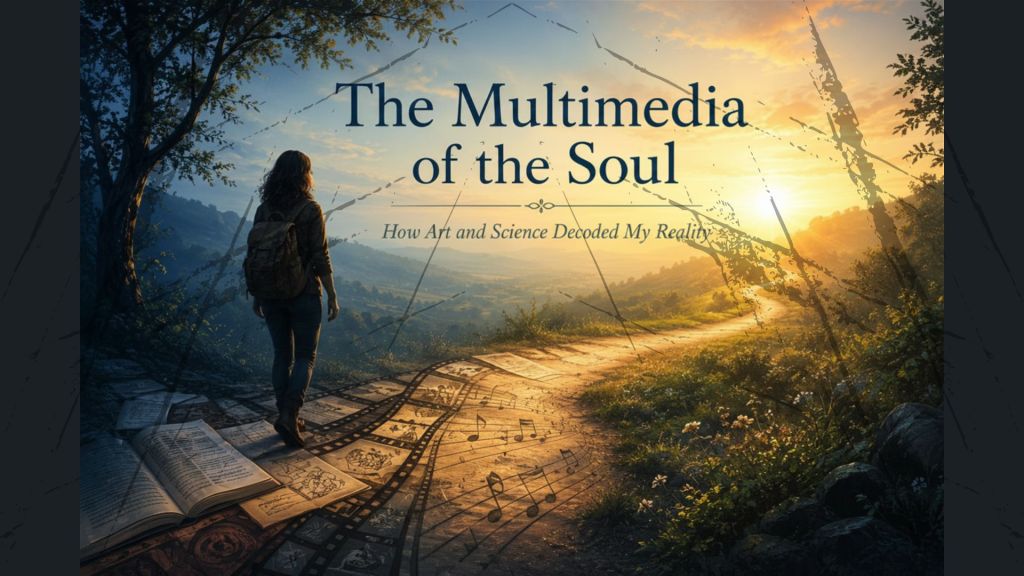
At fifty years of age, I have consumed my fair share of media. But when I sit quietly and look back at the architecture of my own mind, I realize awakening rarely happens in a single flash. We are raised with a specific set of blueprints—a worldview handed down by family, culture, religion, and circumstance. Then, as we grow, we encounter things that crack the foundation of what we were taught. A story, a song, a book, a film, or a lecture arrives at exactly the right moment and acts like a software update for the soul.
For me, that personal philosophy has always been summarized in six simple words:
Love to Live and Live to Love.
When I look back at the media that changed me, I see more than favorite books or memorable songs. I see catalysts. I see moments that invited me to examine inherited scripts, question old narratives, and slowly become more fully myself.
The Soundtrack of a Reclaimed Heart
Part of my upbringing included a rigid, generational doctrine that firmly did not believe in the mixing of races. It was a lesson that flew in the face of love, logic, and humanity, but when you are a teenager standing alone against a family’s deep-seated dogma, the isolation is heavy.
When I was fifteen or sixteen, I fell for a young man who was mixed—Black and white. We were just kids navigating the sweet, innocent space of first love when a family member caught us kissing outside.
The fallout was immediate.
I found myself in immense trouble, pulled away under a cloud of intense judgment simply because of the color of his skin. When I questioned the logic of it, the adult answer I received was flat and absolute:
“You should be with people who look like you.”
Then, a song arrived on the radio like an oasis.
Hearing I Believe by Blessid Union of Souls changed my trajectory. When that song came through the radio, telling a story about a boyfriend being Black and a father who simply could not see things that way, it felt like cosmic validation.
That track gave me emotional permission to trust my own heart over the programming I was being handed. It proved that the love I felt in my soul was natural, and the prejudice surrounding me was the thing that was broken.
Looking back, I do not need biology to justify what my heart already knew. The instruction to “be with people who look like you” was incoherent before it was cruel, because love does not become more or less valid based on skin color. Race has been used to build walls that humanity was never meant to live behind. The lesson I was handed did not protect anything sacred. It only tried to make fear sound like wisdom.
The Gateway Beyond the Script
Music gave me my first oasis, but literature helped me begin questioning the deeper religious scripts surrounding my youth.
I was raised primarily under a strict Evangelical umbrella, but my family’s spiritual landscape was more complicated than one simple label. There were competing doctrines, inherited assumptions, and generational narratives that had been handed down long before I was old enough to examine them.
That does not mean I was raised without intelligence or thought. Some of the smartest people I know came from the same family tree. But intelligence does not automatically free us from inherited scripts. Sometimes brilliant, loving people still pass along stories they themselves inherited.
As a young person trying to make sense of faith, I was searching for a way to believe in something greater that still aligned with the values of my heart.
That was when a dear friend and I picked up Ramtha: The White Book.
Reading it nearly thirty years ago became a turning point.
Looking back, I do not need to agree with every claim connected to the book or the movement around it in order to understand why it mattered to me. At that point in my life, it introduced me to the possibility that inherited beliefs could be examined instead of simply accepted.
For someone raised around rigid answers, that was revolutionary.
The book did not give me a finished worldview. It gave me a question that would follow me for decades:
What do I actually believe?
That question became part of my individuation—the long, sometimes uncomfortable process of separating what I had been taught from what I genuinely knew, felt, observed, and chose. It helped me become an active participant in my own spiritual life rather than a passive recipient of someone else’s certainty.
Breaking the Framework of Reality
Years later, when What the Bleep Do We Know!? crossed my path, it did not feel like a separate awakening so much as a continuation of the same question.
Only later did I realize the documentary grew out of the same broader spiritual movement I had encountered years before. That matters, and I do not want to pretend otherwise. But for me, the value was never in adopting a doctrine. It was in the gateway it opened.
Both the book and the film gave me language for something I was already beginning to ask:
What if the worldview I inherited was not the only way to understand reality?
What if consciousness, perception, belief, and attention mattered more than I had been taught?
The film explored the intersections of quantum physics, neurology, and human consciousness. Whatever scientific liberties the documentary may have taken, it still became a crowbar for me. It pried open a door I had not known how to open yet.
One idea from the film stayed with me in a way that still feels useful: the mind does not give us reality whole. Our brains receive far more information than our conscious awareness can hold, so what we call “reality” is always, at least in part, filtered through attention, interpretation, memory, and meaning.
That gave me a new way to understand human agency. We are not simply passive victims of our environments. We are participants in perception. We notice, interpret, assign meaning, repeat stories, and sometimes mistake those stories for reality itself.
The film did not give me every answer.
It gave me a question wide enough to walk through.
Decoding the Silence and the Light
Eventually, my passion for human behavior led me to graduate-level studies in clinical psychology. During a class in 2013, while I was actively studying the physical structure of the human brain, a professor shared a piece of media that permanently reshaped my meditation practice: Dr. Jill Bolte Taylor‘s TED Talk, My Stroke of Insight.
Dr. Taylor, a neuroanatomist, suffered a massive stroke in the left hemisphere of her brain. She beautifully explained how, as her analytical, language-driven brain functions shut down, she lost the constant internal chatter of past and future. She slipped into a state of connected tranquility—a profound sense of presence and unity.
When I watched that talk, I was struggling with meditation. My mind simply would not stop talking, and that remains the most common frustration I hear from people beginning a practice.
Because I was studying neuroanatomy at the time, her talk gave me an epiphany. I could use her neurological experience as a map. Not a perfect scientific mechanism. A map.
As a neuroanatomist, Dr. Taylor understood the anatomy of the brain in a way few people do. What made her story remarkable was not simply that she experienced a stroke, but that she could describe the loss of specific cognitive functions as it unfolded. As the analytical, language-driven systems she relied upon went offline, she found herself experiencing a different quality of awareness—one marked by spaciousness, present-moment connection, and deep peace.
That distinction helped me understand why meditation had felt so difficult. I was trying to enter stillness while the narrating mind was still running the room.
So I began visualizing that shift during meditation. In my mind’s eye, I gave the analytical mind permission to soften while allowing a more spacious awareness to emerge. I practiced that visualization for a long time.
Technically, the Observer is not a location in the brain at all. The Observer is always there—the quiet awareness beneath the noise, present whenever the mind grows still. You do not have to manufacture it.
It is you.
But by using that visualization to quiet the chatter, I finally cleared the runway to experience it. Once you find that quiet, you realize the Observer has been waiting there the entire time. Sometimes nothing happens during meditation, and that is part of the beauty.
You sit.
You breathe.
You observe.
You learn that stillness does not have to perform in order to be valuable.
Over the years, I have shared many different approaches to meditation, but I often tell people this: if you pray regularly, you already know where to go. You already know the coordinates. You close your eyes and enter that same internal space. The only difference is that instead of speaking, you practice listening.
The Masterpiece of Convergence
When I look at these pieces of media side by side, I see the map of my own evolution.
The song taught me to trust love.
The book taught me to question inherited scripts.
The film challenged me to examine perception.
The lecture taught me how to find stillness.
Together, they became catalysts in a much larger journey—the lifelong work of individuation.
Today, as I practice mindfulness and meditate twice each day, I am still using the tools these pieces of media helped me discover. They helped me step out of inherited armor, examine the narratives I had been handed, heal my nervous system, and move toward a freer way to live.
That work is rarely easy.
Most of us inherit beliefs, loyalties, fears, assumptions, and identities long before we stop to ask where they came from.
But every so often, a piece of media arrives at exactly the right moment and quietly asks the question underneath every script:
Is this truly mine?
Perhaps becoming ourselves has never been about finding all the answers. Perhaps it begins the moment we become willing to ask that question.
Yours in presence, evolution, and sacred alignment,
Terra

YouTube Fab Five: Clifton Chilli Club
Read More >