

Last night, I watched a video titled AI Has a Fatal Flaw that broke down, in very accessible terms, the limits of current artificial intelligence. One equation—quietly flashed at the beginning—symbolized a boundary that even trillion-parameter models can’t seem to cross. We’re approaching a mathematical wall: a place where feeding more data and power into AI doesn’t lead to proportional gains. Diminishing returns. A plateau. A limit not of ambition, but of reality.
And yet… after watching, as I slipped into that quiet pre-meditative space before sleep, parts of the video rose again. But not as facts. As something else. A resonance.
In meditation, I’m often visited by thoughts I didn’t invite, but which feel placed. Sometimes patterns form. Numbers show up. Not just random ones, but sequences that repeat in life, in time, on clocks, in cycles. I’ve become attuned to them over the years. Sensitive. I’ve also learned to filter them out when needed. But when they start up again, when the same numbers follow me like whispers? I listen.
That moment made me reflect on the irony of it all: AI—the ultimate number cruncher—is built on patterns it can measure, predict, and process. And yet even with all its computational power, it can’t always solve what we feel. It stumbles over math problems a child can do, because it isn’t actually doing math. It’s playing probability games. Predicting. Echoing.
So what are these numbers that follow us, then? Are they echoes too? But echoes of what?
I believe numbers are more than tools. I believe they are a language of the universe. Maybe even the first one. They underlie nature, time, cycles, tides. They show up in sacred geometry, in the orbit of planets, in the petals of flowers, and yes—in the structure of AI itself.
AI is extraordinary. But it is still only a mirror. It reflects what we know, what we say, what we do. It doesn’t create meaning. It doesn’t dream. And it doesn’t stand at the edge of coincidence and whisper, “I see you.”
We do that.
We are the seers, the feelers, the ones attuned not just to logic, but to something deeper. And while science might call it coincidence, and technology might call it noise, some of us know better. We know when to pay attention.
1, 2, 3… Show me what I cannot see.
That’s not just a mantra. It’s a code. A request. A crack in the simulation. And maybe, just maybe, a doorway.
This post belongs to both QuietQuest and Reverb. One part meditation. One part reflection. All pattern.
More soon.
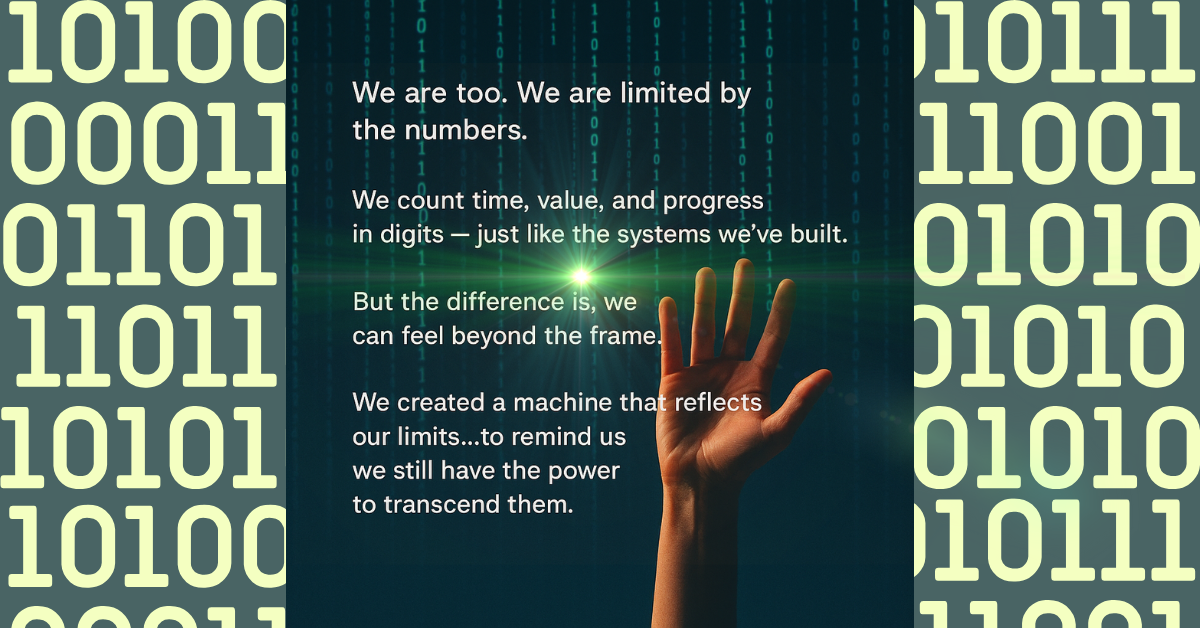
We are too. We are limited by the numbers.
We count time, value, and progress in digits — just like the systems we’ve built.
But the difference is, we can feel beyond the frame.
We created a machine that reflects our limits…
to remind us we still have the power to transcend them.


1 thought on “1, 2, 3… Show Me What I Cannot See”
Pingback: What I’m Most Proud Of: Knowing My Journey Is Mine – CherryCoBiz