

Sometimes the best discoveries are not recipes.
They are frameworks.
Recently, I stumbled across a creator named Marianna Moore making noodle jars. She is funny, honest, and refreshingly real, and one of the things I appreciated right away was how approachable she made the whole idea feel.I have
The concept immediately caught my attention. Not because I planned to copy her recipe exactly, but because the format just made sense: vegetables, protein, crunch, and flavor. A full meal layered into a portable container and ready when needed.
That is the kind of idea that fits beautifully into my health and wellness journey.
The original video used kelp noodles, and my first instinct was to try something close to that. Unfortunately, I could not find exactly what I was looking for, and the options I did find were more expensive than I wanted to spend for what was essentially an experiment.
So I started researching alternatives.
That is how I discovered heart of palm noodles.
I picked up a six-pack of Natural Heaven Hearts of Palm Spaghetti and decided to see where the idea would take me.
According to the packaging, the noodles are made from hearts of palm, are low calorie, vegan, gluten-free, and do not require rinsing. I rinsed mine anyway because I had watched someone recommend it, but later I tried a few straight from the package and honestly did not find the flavor off-putting.
To me, they reminded me a little of artichoke, maybe a little avocado, with something slightly nutty underneath. Not in texture, but in flavor.
Once they are mixed into the cup, though, they mostly take on the flavor of everything around them.
That is where things got interesting.
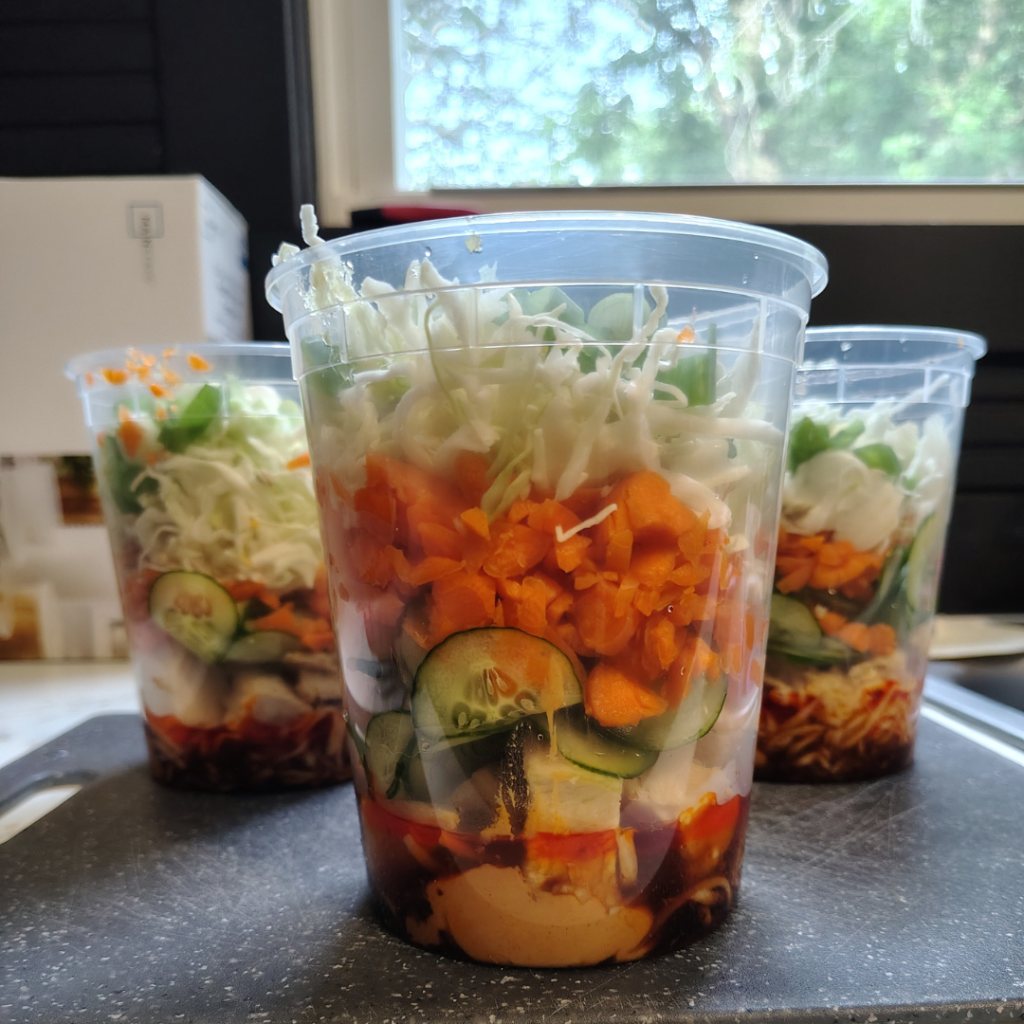
The First Experiment
The first version leaned Asian-inspired.
The funny thing is that I actually bought ingredients that would have allowed me to make something much closer to Marianna’s original version—and then I didn’t.
Somewhere between watching the video, shopping for ingredients, and standing in my kitchen, the recipe became my own.
I layered in peanut butter, rice vinegar, coconut aminos, fresh garlic, chili crunch, chicken, cucumber, carrots, cabbage, green onion, and sunflower seeds over the heart of palm noodles.
Thankfully, it worked really well.
The cup was huge.
And I don’t mean “healthy food pretending to be a meal” huge—it was actually huge.
Packed with vegetables, protein, texture, and flavor, I couldn’t finish it all myself.
My husband stepped in to finish the rest, and my best friend enjoyed it too.
My son, who has earned the title of resident picky eater over the years, did not even try it.
His loss, not ours.
Why These Cups Matter
The more I thought about it, the more I realized the real discovery was not heart of palm noodles, chili crunch, or even the specific recipe.
It was the format.
This is why these cups remind me so much of my dirty cabbage dishes.
Dirty Cabbage in the Rescued Wok
The Versatility of Dirty Cabbage
Those posts were never really about cabbage.
They were about finding a flexible framework that helps me get more vegetables into my life without making healthy eating feel complicated.
These cups feel exactly the same.
The dressing changes.
The vegetables change.
The protein changes.
The flavors change.
But the framework remains.
That is also where the 32-ounce containers enter the story.
I bought them because of this idea—not because I was trying to become a meal-prep expert, but because the concept made practical sense.
The funny thing is that we did not actually make these to put in the refrigerator for later.
We made them.
Shook them up.
And ate them almost immediately.
In fact, both versions were enjoyed fresh.
What changed was the realization that they could easily become meal prep if we wanted them to.
The format works either way.
Make one for lunch today.
Make several for the week ahead.
The flexibility is part of the appeal.
I do not know exactly how these cups will evolve in our kitchen yet, but I can already see the potential.
Sometimes wellness is not about committing to a system forever.
Sometimes it is about discovering a tool that gives you more options.
The Second Experiment
A few days later, I made a Greek-inspired version.
My husband had been looking forward to Version Two, but trucking had other plans. His schedule changed again, and he ended up leaving before he had a chance to try it.
That is life with a truck driver.
The Greek version used heart of palm noodles, Primal Kitchen Greek Vinaigrette, a small splash of lemon juice, fresh garlic, chicken, cucumber, cherry tomatoes, red onion, and feta cheese.
It was completely different from the first version.
And that is exactly the point.
The Greek dressing brought the flavor I was hoping for.
Sometimes “Greek-inspired” products do not really taste all that Greek to me, but this one did.
The vinegar, herbs, oregano, and lemon notes worked beautifully with the feta, tomato, cucumber, and onion.
In hindsight, I could have used a little more lemon juice.
I also wish I had pepperoncinis.
Olives would have worked.
Artichokes would have worked.
Broccoli might be wonderful.
Even cheddar could be interesting in the right version.
That is what I mean when I say this is a framework.
Once the format works, the possibilities start opening up.
The Evolution Continues
As I was thinking through all of this, I came across another creator talking about lupini beans.
That said, I immediately noticed the price point. The jars I added were nearly $25 for two jars, which is not exactly budget-friendly in today’s economy. If I end up loving them, they may earn a place in my rotation. If not, I have plenty of other affordable options available, from chicken to tofu to black beans.
Either way, I appreciate creators who introduce me to ingredients I might never have discovered otherwise. Whether lupini beans become a regular part of my kitchen or not, they have already expanded my curiosity—and that’s valuable all by itself.
I have not tried them yet.
I have never purchased them myself, and I do not recall ever intentionally eating them. It is entirely possible I have encountered them somewhere along the way, but if I have, I did not know what they were at the time.
What caught my attention was the sheer possibility.
Jarred lupini beans are already prepared and ready to eat, meaning they could easily become another quick protein option for these cups.
Chicken, tofu, lupini beans—the rotation stays completely fresh with different vegetables, different dressings, and different flavors.
That is what keeps pulling me back to this idea.
Not because I found one perfect food.
Because I found another way to keep good food interesting.
That matters.
Healthy habits are easier to maintain when they do not feel repetitive, restrictive, or boring.
The more options I have, the more likely I am to keep choosing them.
For me, these cups are another practical tool in the wellness toolbox.
A way to build a real meal.
A way to use what I have.
A way to keep experimenting without starting over every time.
That feels useful.
That feels sustainable.
And honestly, that feels very CherryCoBiz.
Recipes
Asian-Inspired Heart of Palm Noodle Cup
Dressing (For One 32-Ounce Container)
- 1 tablespoon peanut butter
- 1 tablespoon rice vinegar
- 1 tablespoon coconut aminos
- ½ tablespoon chili crunch
- 1 clove fresh garlic, minced
Cup Ingredients
- Heart of palm noodles (optional rinse)
- 4 ounces cooked chicken breast
- ½ cup cucumber, chopped
- ¼–½ cup carrots, finely chopped
- 1 cup angel hair cabbage
- 1 green onion, sliced
- 1–2 tablespoons sunflower seeds
Instructions
- Add the dressing ingredients to the bottom of the container and stir to combine.
- Add the heart of palm noodles directly over the dressing.
- Layer in the chicken and vegetables.
- Top with sunflower seeds.
- Seal and refrigerate until ready to eat, or shake and enjoy immediately.
- Toss or shake vigorously before serving.
Greek-Inspired Heart of Palm Noodle Cup
Dressing (For One 32-Ounce Container)
- 2 tablespoons Primal Kitchen Greek Vinaigrette
- Small splash of lemon juice
- 1 clove fresh garlic, minced
Cup Ingredients
- Heart of palm noodles (optional rinse)
- 4 ounces cooked chicken breast
- ½ cup cherry tomatoes, sliced in half
- ½ cup cucumber, chopped
- ¼ cup red onion, finely chopped
- ¼ cup feta cheese, crumbled
Optional Additions
- Pepperoncinis
- Olives
- Artichokes
- Broccoli
- Sunflower seeds
Instructions
- Add the dressing, lemon juice, and garlic to the bottom of the container and stir to combine.
- Add the heart of palm noodles.
- Layer in the chicken, tomatoes, cucumber, red onion, and feta.
- Seal and refrigerate until ready to eat, or shake and enjoy immediately.
- Toss or shake vigorously before serving.
Estimated Nutrition
Nutrition will vary depending on ingredient amounts, dressing, cheese, seeds, and protein choice.
For the Asian-inspired version:
- Approximately 375–425 calories
- Approximately 32–36 grams of protein
For the Greek-inspired version, nutrition will vary depending on how much feta, chicken, and dressing you use.
P.S. If you’re looking closely at the recipe measurements, know that many of them are rough estimates. I wasn’t standing in the kitchen with measuring cups and a food scale. I was preparing ingredients, layering what sounded good, and building cups that looked and felt right.
My vegetable choppers deserve some credit too. They handled most of the chopping.
I have a funny relationship with sharp things. Needles don’t bother me at all, but knives, can tops, box cutters, and anything else that looks eager to remove a fingertip tend to get my full attention.
I still use them, of course, but I genuinely appreciate having help in the kitchen. I’m also the person constantly reminding everyone to be careful. Don’t cut yourself. Watch your fingers. Slow down.
It’s probably less about the knives and more about the fact that I’m a mom.
My family laughs when I throw an arm across someone during a sudden stop in the car, as though I can somehow save the day. Apparently that instinct follows me into the kitchen too.
Whatever was left over went back into the refrigerator to become part of something else later.
Maybe another noodle cup.
Maybe a salad.
Maybe something I haven’t thought of yet.
For me, healthy eating gets a lot easier when I stop chasing perfection and start working with what I have.



YouTube Fab Five: Clifton Chilli Club
Read More >