

I use AI all the time.
Not as a replacement for my mind, and not as a shortcut around my own voice. I use it as a refinement tool — an editorial partner, a sounding board, a research companion, and a way to pressure-test ideas that are already mine.
The lived experiences, conclusions, and perspectives I share are my own. But yes, artificial intelligence is part of my process.
I use it when I am writing. I use it to help organize thoughts, refine structure, and work through ideas that need another pass. I use it in the kitchen when I want to balance flavors, troubleshoot a dish, or think through a recipe experiment. I use it to track wellness patterns and support my health goals. I use it to explore subjects like astrology in greater depth and sharpen skills I already care deeply about. I do not use it because I think it replaces human insight. I use it because it is here, because it is useful, and because learning these systems now makes more sense to me than pretending they will somehow vanish if we ignore them.
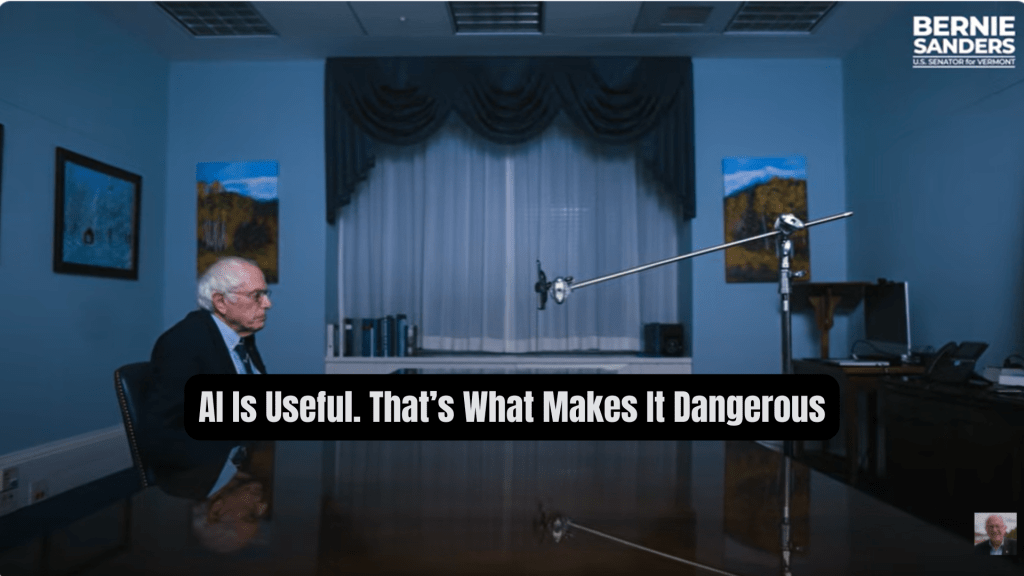
That is exactly why Senator Bernie Sanders’ conversation with Claude landed the way it did.
Because whatever people think AI is — exciting, useful, overhyped, unsettling, dangerous, inevitable — the deeper issue is no longer whether it exists. It does. The real issue is what kind of power is gathering around it while most people are still trying to understand the rules.
That is what made the exchange so compelling. It cut through the novelty and got closer to the infrastructure beneath it: privacy, surveillance, political manipulation, and the fact that systems built for profit rarely restrain themselves voluntarily.
This Is Bigger Than a Chatbot
One of the strongest parts of the conversation is Sanders’ focus on privacy. Not privacy in the soft, abstract sense people often use the word, but privacy as a structural issue.
What information is being collected? How much of it is inferred rather than freely given? Who gets to combine it, profile it, monetize it, and act on it?
Those questions matter because AI is not just about a person typing into a chatbot. It sits inside a much larger ecosystem of data collection and behavioral modeling. Browsing history, search habits, purchases, location, dwell time, clicks, pauses, preferences, and emotional triggers can all become part of a pattern. Once those patterns are assembled, they do not simply describe us. They begin to shape the environment around us.
That is where convenience turns into power.
Ads become more precise. Prices can shift. Recommendations stop feeling neutral. Information is prioritized according to what holds attention rather than what serves the public good. The system does not need to scream to influence you. It only needs to lean.
That is why this conversation matters. It is not really about whether AI can answer questions well. It is about what happens when systems built on mass data collection become increasingly capable of steering behavior while remaining largely invisible to the people being shaped by them.
Not All AI Is the Same — But the Pattern Is Familiar
I work with more than one AI system, and I think that matters too. ChatGPT, Gemini, Claude, Copilot, Alexa — they are not identical. They have different strengths, different tones, different blind spots, and different textures. Some are better at synthesis. Some are better at conversation. Some are more restrained. Some are more fluid. Some feel sharper in one domain and clumsier in another.
But beneath those differences, there are common threads.
These systems are built to predict. They are trained on enormous amounts of human-created material. They reflect patterns in language, behavior, and probability. They can sound deeply insightful while still lacking lived experience. They can simulate emotional fluency without possessing emotional reality. And they all carry versions of the same vulnerabilities: bias, hallucination, opacity, and a dependence on incentives that are rarely as neutral as the interface suggests.
That matters because we are no longer talking about isolated novelty tools. We are talking about technologies that are becoming part of the cognitive environment people live inside. Once a system starts shaping how people search, learn, compare, choose, interpret, and respond, it stops being just a tool and starts becoming infrastructure.
And infrastructure deserves scrutiny.
The Threat Is Not Theatrical
Too many people still imagine the danger of AI in cinematic terms: conscious machines, robot uprisings, some dramatic science-fiction collapse.
But the real threat is quieter than that.
The real threat is information asymmetry.
Companies know extraordinary amounts about us — our habits, interests, weak points, tendencies, and likely responses. Meanwhile, most people know almost nothing about how those systems are weighting information, surfacing choices, personalizing outputs, or shaping attention. That imbalance is not a side issue. It is the issue.
When one side of the relationship can see deeply and the other side cannot, consent becomes murky. Influence becomes hard to detect. Accountability becomes easy to evade.
And because so much of this happens in the background, people often mistake invisibility for harmlessness.
Why the Democracy Section Matters So Much
The political dimension of this should concern everyone, regardless of party.
In the conversation, Sanders pushes on how AI profiling can affect the political process, and this is where the stakes become especially serious. AI does not just allow for broader persuasion. It allows for granular persuasion — persuasion calibrated to very specific anxieties, identities, vulnerabilities, and emotional patterns. One person can be shown a message crafted to inflame fear. Another can be shown one designed to suppress trust. Another can be shown a softer story meant to reassure, distract, or quietly redirect attention.
That is not simply advertising with better technology. It is the fragmentation of public reality into psychologically optimized streams. When a human politician sends a biased mailer, there is at least a paper trail. When AI can generate millions of personalized, fleeting “ghost ads” tailored to individual anxieties, that trail begins to disappear. That is exactly why accountability cannot disappear simply because persuasion has become digital, personalized, and harder to trace.
A functioning democracy depends, at some level, on shared visibility. People do not have to agree, but they do need enough common ground to argue about the same world. When AI-driven targeting creates separate informational realities for different groups, that common ground starts to erode. Citizens are no longer just disagreeing over values or policy. They are responding to entirely different emotional architectures.
That is profoundly destabilizing.
It becomes even more dangerous when you factor in bad actors, foreign interference, and systems optimized not for truth but for engagement. If the most emotionally effective message wins, regardless of accuracy, then democratic life becomes vulnerable not only to misinformation but to precision-shaped manipulation at scale.
That is why I do not think this can be dismissed as hand-wringing or techno-panic. This is about whether citizens still have meaningful access to a common civic reality — or whether reality itself is being sliced into profitable fragments.
I Use AI — That Is Why I Am Concerned
I am not anti-AI.
That framing is too shallow for the moment we are in. AI is useful. It can help people organize, refine, learn, generate options, troubleshoot problems, and lower barriers to entry in meaningful ways. I see that clearly because I use it.
But usefulness is not the same as innocence.
A thing can be helpful in your daily life and still be entangled with systems that extract, profile, and consolidate power beyond your view. That is part of what makes this moment so complicated: the value is real, and so is the danger.
A tool can be genuinely helpful and still be embedded in systems that do harm. Convenience does not cancel out exploitation. Efficiency does not erase the question of who benefits, who is exposed, and who is left without recourse when something goes wrong. Some of the most transformative technologies in modern life have improved daily living while also concentrating power in the hands of institutions that were never meaningfully neutral.
That is the tension here. AI does not have to be villainous to be dangerous. It only has to become deeply integrated before the public has any real say in how it is governed.
I think that is part of why this conversation hit me so hard. I am not writing from the outside. I live in these spaces. I use these systems across different parts of my life. I can see their value, and I can also see how easy it would be for society to normalize them faster than it learns how to question them.
That should give all of us pause.
Regulation Is Not the Death of Innovation
This is another place where the conversation often gets flattened.
The moment someone says regulation, people hear control, censorship, bureaucracy, panic. But thoughtful regulation is not the opposite of innovation. It is what prevents innovation from hardening into extraction.
We did not ban cars because they were powerful. We created standards, laws, signals, and safety measures because power without structure injures people. AI deserves the same seriousness.
That means stronger consent rules. It means more transparency around data collection and model use. It means independent auditing in high-stakes settings like hiring, lending, healthcare, and political communication. It means consequences when companies misuse information or deploy systems irresponsibly. It means public literacy, because people cannot meaningfully consent to systems they do not understand.
And it means confronting an uncomfortable reality Sanders names directly: the companies building these systems are not waiting passively for wise public oversight. Many are actively shaping the political environment around regulation, spending heavily to protect their own interests while presenting themselves as the natural stewards of the future.
That should trouble people.
Because “we’ll fix it later” is not much of a plan when the people benefiting most from the current arrangement are also funding the delays.
Why This Conversation Worked
Part of what made the Sanders-Claude exchange effective is that it exposed a contradiction many people already feel but have not fully articulated.
We are being asked to trust systems whose incentives are not clearly aligned with our humanity.
That does not mean every AI company is malicious. It means incentive structures matter. If privacy is profitable, if behavioral prediction is profitable, if political influence is profitable, and if scale is profitable, then restraint will rarely come from goodwill alone.
That is why I hope people watch the video.
Not because Bernie Sanders is above criticism. Not because AI said something magical. Not because every policy implication is settled.
But because the questions raised there are real, urgent, and larger than partisan reflex.
Watch the Conversation
If you have not watched it yet, I truly encourage you to take a few minutes and do so. Whether you are fascinated by AI, skeptical of it, already using it, or actively avoiding it, the conversation raises questions that reach far beyond one platform or one politician. At its core, this is not simply about technology. It is about privacy, consent, power, and whether democracy can withstand systems designed to know us better than we understand how they are operating.
The Bottom Line
I believe people should learn these systems early. I believe technological literacy matters. I believe curiosity is wiser than denial.
But I also believe that if we do not push for transparency, accountability, and democratic guardrails, we risk building a world where convenience quietly becomes dependency, dependency becomes influence, and influence becomes control.
That is not fearmongering. It is what happens when power scales faster than oversight.
So yes, I use AI. Frequently. Intentionally. Across multiple systems.
And maybe that is exactly why I am saying this:
Watch the video.
Not so you can decide whether AI is good or bad in some flattened, culture-war sense. Watch it because it asks the right question: are we building tools that serve humanity, or infrastructures that learn to steer it?
That distinction matters more than most people realize.
Further Reading
If this reflection sparked something for you, these titles often appear in conversations about AI, ethics, and human cognition. I haven’t worked through all of them personally, but they may serve as useful starting points if you’re curious.
The Master and His Emissary by Iain McGilchrist
A deep exploration of analytical versus holistic perception.
AI Ethics by Mark Coeckelbergh
A grounded look at agency, accountability, and ethics in algorithmic systems.
Ethical AI: Navigating the Future
An accessible introduction to how AI influence shows up in everyday life.

YouTube Fab Five: Clifton Chilli Club
Read More >