

What Indigenous Critique Reveals About Christianity, Certainty, and Freedom
Content Note: This reflection discusses religion, colonialism, inherited belief systems, and spiritual deconstruction. It is not written to mock sincere faith, but to make space for honest questioning. If this topic feels tender for you, take your time.
Some stories do more than inform. They clarify.
That is what happened while watching Why Christianity Hates Indigenous People by Genetically Modified Skeptic. What began as a compelling historical and philosophical video quickly became something more personal for me. Not because I agreed with every word as some final doctrine, but because it touched a nerve I have felt for most of my life.
A very old nerve. A very familiar one.
The kind that begins with a child asking questions and being told, in one way or another, that the answers have already been settled.
This reflection is not really about attacking Christianity. It is about what happens when a religious system becomes so certain of itself that it can no longer recognize goodness, dignity, intelligence, or moral clarity outside its own walls.
It is about what happens when faith stops being a path and starts behaving like property.
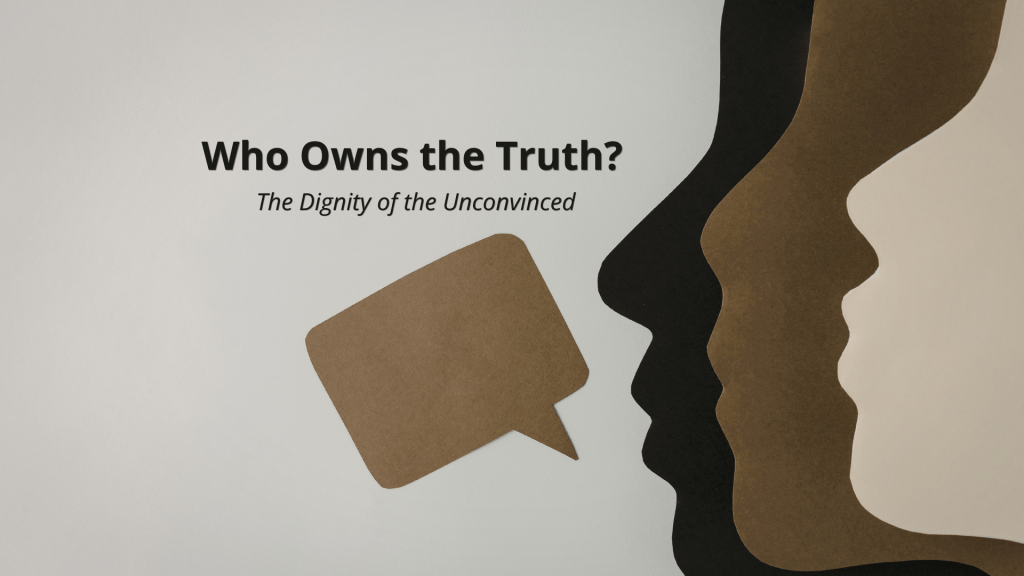
It is about the right to doubt, the dignity of the unconvinced, and the freedom to ask who gets to claim truth in the first place.
Watch the Video That Sparked This Reflection
If the video above speaks to you, I encourage you to watch it in full. It is thoughtful, historically grounded, and rich with questions that reach far beyond religion alone.
When “Truth” Arrives Like a Mission
One of the most striking parts of Drew’s video is the story of missionary Daniel Everett, who entered the Amazon with a clear purpose: translate the Bible, convert the Pirahã people, and bring them what he believed was the greatest gift imaginable.
That opening moved me immediately.
There is something profoundly human about beginning with one purpose, only to realize your purpose has changed. Sometimes we arrive somewhere convinced we are the teacher, only to discover that we are the one being undone. Not destroyed. Not humiliated. Changed.
That matters.
There is nothing wrong with starting with certainty and later realizing that certainty no longer fits. In fact, some of the most honest transformations happen that way. People cling to an old purpose until reality, humility, or experience softens their grip enough for truth to enter from another direction.
Everett came to convert. Instead, he encountered a people who did not need what he was selling.
And that is where the deeper problem begins.
So much missionary thinking depends on a hidden assumption: that the people being approached are spiritually lacking, morally incomplete, or waiting in darkness for someone else to explain life to them.
But what if they are not?
What if the people being “saved” already have meaning, ethics, laughter, belonging, and dignity? What if the missionary’s certainty says more about the missionary than the people he hopes to convert?
Morality Is Not Owned by Christianity
This part matters to me personally.
I no longer follow Christianity. But I did not lose my morality when I left it.
I still try to live honestly. I still believe in accountability. I still try to treat people with respect. I still wake up every day with purpose. I still tell hard truths when I feel they matter. I still care about being a good part of this world, imperfectly but sincerely.
And I am happy.
Mostly.
That may sound simple, but for many people raised in evangelical spaces, it is not simple at all. We were often taught, directly or indirectly, that Christianity was not just a path to morality, but the path. That without it, people drifted into confusion, selfishness, or spiritual emptiness.
But that is not what I found.
I found that leaving Christianity did not strip me of conscience. It stripped me of certainty that had been handed to me as if it were the same thing as truth.
There is a difference.
One of the most powerful threads in Drew’s video is the way the Pirahã community complicates the Christian assumption that belief in God is necessary for human flourishing. The discussion of laughter, visible joy, mutual care, and communal life struck me deeply. In many ways, it felt like an example of positive psychology expressed through culture: connection, reciprocity, meaning, humor, trust, and care for one another embedded in daily life.
That matters because one of the quiet myths religion often tells about doubters is that once belief disappears, meaning disappears with it. But meaning is not owned by religion. Meaning-making is a human faculty. People build it through relationship, care, resilience, ritual, creativity, humor, responsibility, and purpose. Faith can be one container for that, but it is not the only one.
The Pirahã, at least as presented in this conversation, did not look morally hollow. They cared for elders. They shared resources. They laughed in hardship. They lived relationally. They were not perfect—no one is—but they were not empty.
That should force a serious question: if goodness already exists outside Christianity, why does Christianity so often struggle to admit it?
“Meaning is not owned by religion. Meaning-making is a human faculty.”
I Was Raised to Believe We Were Right
That question started early for me.
I was raised in a world where my religion was understood to be the right religion. Not one among many. Not one interpretation among many. The right one.
That belief does something to a child.
It teaches you to look outward and assume others are missing something. That they may need testimony, an invitation to church, or a conversation about Jesus so they, too, can be saved. It frames difference not as difference, but as deficiency.
And even as a little girl, that unsettled me.
I remember watching television in the late 70s or early 80s and noticing Catholics in shows—priests, nuns, things like that. I asked Little Grandma Rose why you only saw Catholics on TV. My vantage point back then was small, limited, and shaped by what I had been given. I was trying to make sense of a religious world much larger than the one I knew.
She answered from where she stood. Not cruelly. Not harshly. Just from her world.
Something along the lines of: they do not care about their faith the same way, or they pray to Mary, or they worship idols. She would not outright say they were condemned. That was not really her way. But the message was still clear enough: they were different, and our way was the safer, truer, more faithful one.
But I kept wondering.
If a nun gives her whole life to God, how could God not love her? If a priest devotes himself completely, how could he be outside the circle? How are they wrong and we are right? How are we so special?
Those questions stayed with me.
What I understand now—many years later—is that Little Grandma Rose could only answer my curiosity from her own life and position. She was not withholding some grand hidden wisdom. She was answering from the only framework she had. And that realization fills me with more tenderness than resentment.
Her life was not mine.
Little Grandma Rose grew up in different conditions, under different pressures, with different structures around belief, family, gender, survival, and meaning. It is easy now for me to imagine why remaining inside a familiar ideology may have felt not just safer, but necessary. At a certain point, it becomes easier to remain inside certainty than to wander into the unknown.
And the unknown is lonely sometimes, especially when all the people you know and love are standing so close to you.
The Collision of Inheritances
Part of what made questioning possible for me, I think, is that I was never shaped by just one inheritance.
I am Cherokee. I have my citizenship with the Cherokee Nation. I am also Ashkenazi Jewish. And I was raised inside a strong evangelical framework. My family, in many ways, is transreligious. We have evangelicals, Baptists, Jehovah’s Witnesses, and Jewish branches. That alone complicates any neat idea that one tradition arrived pure, untouched, or unquestionably supreme.
When more than one truth-claim lives in the same family tree, certainty starts to crack.
Evangelical Christianity taught me one story about salvation, authority, and who was right. But my Indigenous line complicates that story because Christianity did not arrive on this land innocent. It arrived entangled with conquest, assimilation, erasure, and the assumption that other people’s sacred ways were disposable. My Jewish line complicates it differently. It reminds me that tradition, survival, interpretation, and identity can take many forms, and that no one culture gets to declare itself the center of human meaning without leaving wreckage behind.
I do not say this to pretend I carry some perfect answer because of where I come from. I say it because collision teaches. When multiple inheritances live inside one person, it becomes harder to pretend one script explains the whole world.
Maybe that is part of why I no longer fit inside the certainty I was given.
Sometimes I think the Cherokee line helped me see religion differently. Sometimes I think it was the Jewish side. Sometimes I think it was simply growing up close enough to many inheritances to realize that none of them could honestly claim the whole of reality.
Maybe all of it mattered.
That realization did not make me an atheist. It made me more honest.
I do believe there is something under the surface of this life. Something deeper than performance, doctrine, status, and certainty. But what that is, no man can fully tell you. No man knows.
And I no longer trust people who speak as though they do.
“When more than one truth-claim lives in the same family tree, certainty starts to crack.”
Reward, Punishment, and the Failure of Coercion
One line from the video hit like a bell: telling me I will be rewarded for agreeing with you or punished for thinking for myself does not exactly make your religion sound more legitimate.
Yes. That.
It is such a clean and devastating observation because it exposes a deep weakness in coercive religion. If your best argument is heaven for agreement and hell for dissent, you are not persuading me through truth. You are trying to govern me through fear.
That does not sound holy to me. It sounds insecure.
And it reminds me of what I felt very young, even before I had the language for it: if a belief system is true, why must it so often lean on threat? Why does it need eternal punishment hovering in the background whenever questions get too close to the bone?
The Indigenous critiques Drew shared feel so powerful because they do not just reject Christianity emotionally. They expose its epistemological weakness. They ask for evidence. They question authority. They point out contradiction. They refuse to confuse confidence with proof.
And perhaps most importantly, they do not automatically grant Christianity moral superiority just because Christianity claims it for itself.
That is a lesson the modern world still needs.
The Dignity of the Unconvinced
This may be my favorite thread in the whole video.
At one point, the exchange lands here in spirit: I do not stop you from believing what you believe. I only ask that you allow me to doubt your claims.
That is such a dignified position.
It is not domination. It is not conquest. It is not the desire to erase another person’s faith. It is the defense of a pluralistic space where both people remain free to think.
That is where this piece reaches beyond religion for me.
I do not need everyone to deconstruct the way I did. I do not need everyone to let go of Christianity. I know some people find real peace, structure, comfort, and beauty there. I have known believers who radiate grace and sincerity. I do not deny that.
But I do deny the claim that questioning is rebellion against goodness.
I deny the idea that freedom belongs only to belief and not to doubt.
I deny the assumption that Christians may preach, convert, interpret, and persuade, but everyone else must stay quiet to be considered respectful.
Pluralism has to include the right to think differently. The right to hesitate. The right to say, “I do not know.” The right to be unconvinced without being pathologized, pitied, or threatened.
That is not hostility. That is intellectual dignity.
What Time Taught Me About Inherited Scripts
As I get older, I find myself returning again and again to the difference between inherited ideals and lived reality.
There was a time when I thought my life should look like the lives of the women before me. That their framework was the stable one, the faithful one, the model to mirror. But my life unfolded differently. My mind unfolded differently. My questions did not quiet down just because tradition would have preferred they did.
I know now that questioning religion was not separate from the rest of my life. It was part of a larger pattern of outgrowing inherited scripts—about love, marriage, identity, and what a meaningful life is supposed to look like.
Time changes the lens. Experience changes the lens. Reflection changes the lens.
What once felt certain can become complicated. What once felt universal can reveal itself to be historical, cultural, inherited, and incomplete. What once felt holy can start to feel like a structure built by people trying to survive, explain, control, or endure.
That does not mean everything is false. It means everything must be examined.
And truth, as I have come to understand it, does not fear examination.
What Indigenous Critique Reveals
What Indigenous critique reveals—at least in this context—is not simply that Christianity was wrong in some abstract sense. It reveals that Christianity has often mistaken itself for the whole of moral and spiritual reality.
It reveals the arrogance of assuming others are waiting to be completed by your beliefs.
It reveals how easily religion can become entangled with colonial power when it treats difference as ignorance.
It reveals that people outside Christian frameworks may possess wisdom, ethics, joy, and coherence without needing theological rescue.
It reveals that doubt is not always the enemy of meaning. Sometimes it is the beginning of honesty.
And maybe most importantly, it reveals that freedom of belief means very little if there is no equal freedom to remain unconvinced.
Final Thought
I was raised to believe we were right.
I was raised inside a world where certainty came prepackaged, where faith was treated as virtue, and where too much questioning could make people nervous. But even then, something in me kept asking: how do we know? Why us? Why this version? Why should inherited confidence count as truth?
I do not ask those questions because I hate faith.
I ask them because I respect truth too much to pretend certainty and truth are the same thing.
I ask them because morality did not leave me when Christianity did.
I ask them because I have seen too much beauty, too much sincerity, and too much depth in human beings outside any single doctrine to believe one tradition owns goodness.
And I ask them because freedom must include the right to doubt.
Not the right to dominate. Not the right to erase. Not the right to sneer.
The right to think. The right to question. The right to say, peacefully and honestly:
You may keep your gospel.
I only ask that you allow me my doubt.
“I respect truth too much to pretend certainty and truth are the same thing.”
Further Reading
If this reflection resonates with you, here are a few related pieces that explore similar questions from different angles:
Genetically Modified Skeptic: Question Everything
A spotlight on Drew McCoy’s work, his intellectual honesty, and the courage it takes to question what you were raised to believe. It is less about atheism as identity and more about inquiry as practice.
A reflection on Bill Burr, belief, and why certainty isn’t sacred
A very different kind of piece, but one that touches the same nerve: what happens when humor slices through spiritual performance and exposes how much certainty often depends on repetition, authority, and inherited fear.


YouTube Fab Five: Clifton Chilli Club
Read More >