

A Reverb x Civicus Reflection
Last night I watched a seven-year-old video titled “World of Warcraft Made Trump President.”
It was fascinating.
Clean.
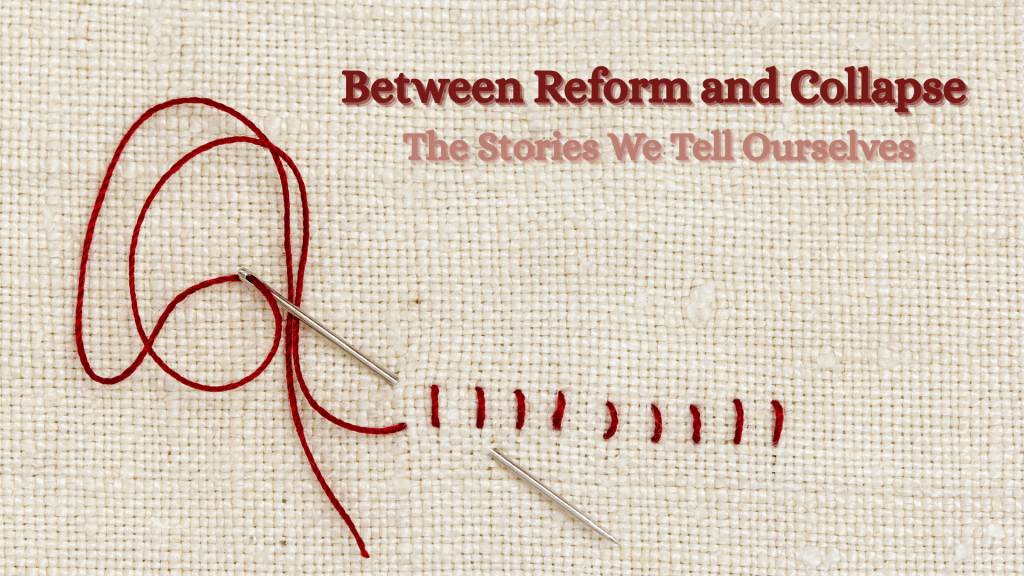
Neatly stitched.
It took gamer culture, gold farming, Steve Bannon, meme warfare, and Trump’s rise — and wrapped them into a single, satisfying arc.
And that’s exactly why it hit me.
Because it was too neat.
The “WoW” connection turned gamers into something almost mythic — a unified force, a digital army, a cultural monolith. A single pipeline from dungeon raids to presidential politics.
That kind of stitching is seductive.
It feels explanatory.
But neat stories are often compression.
And compression can hide complexity.
My immediate reaction wasn’t partisan.
It was psychological.
Why would they?
What’s the end goal?
Who is pulling the strings?
I could feel my brain trying to resolve the tension.
Because we are living through Trump 2.0.
We are watching rhetoric escalate.
We are watching religion entangle with policy.
We are watching rights debated.
We are watching immigrants framed as threat.
We are watching institutions strain.
When the heat rises, the brain seeks cooling.
And cooling often comes in the form of story.
We Are Meaning-Making Machines
The human brain prioritizes coherence over correctness.
When the world feels unstable, inconsistent, or morally inverted, it triggers cognitive dissonance — a psychological itch.
And to scratch it, we build narratives.
Nassim Taleb calls this the narrative fallacy — our tendency to turn disconnected facts into a cause-and-effect story.
The goal? Predictability.
The trap? Once we stitch the story, we stop examining the threads.
A pattern feels safe.
Randomness feels dangerous.
The WoW pipeline story felt safe.
It took chaos and placed it inside a box.
But reality is rarely that clean.
The Need for Closure
Psychologists call it the “need for cognitive closure.”
When inconsistencies pile up, stress rises.
And here’s the uncomfortable truth:
The brain will accept a flawed explanation over no explanation.
We would rather be wrong and certain
than right and confused.
I felt that pull.
That doesn’t make me foolish.
It makes me human.
The Sliver Problem
In my book, I’ve been writing about how we only ever see a sliver of reality.
No one sees the whole.
But boxed narratives pretend we do.
They take a fragment of truth —
digital culture matters,
outrage matters,
media ecosystems matter —
and stretch it into a complete worldview.
The box feels like clarity.
But it’s often just a magnified sliver.
And when we mistake a sliver for the whole, we become overconfident.
Overconfidence accelerates.
Reform vs. Demolition
Here’s where this gets personal.
I believe we have overregulated in places.
I believe institutions calcify.
I believe bureaucracies become self-protective.
That’s reform territory.
But demolition rhetoric is different.
“Drain the swamp” isn’t reform language.
It’s delegitimization language.
And when rhetoric shifts from
“Adjust this”
to
“This entire system is illegitimate”
Velocity increases.
Velocity feels like heat.
And heat makes the brain desperate for narrative cooling.
Accelerationism & Collapse Fantasies
In my post No One’s Coming to Save Us, I wrote about accelerationism — the belief that collapse can be sped up to create something better.
Collapse as purification.
Collapse as reset.
But complex systems don’t collapse cleanly.
They fracture.
And the fracture lines rarely spare the vulnerable.
That’s why accelerationist thinking unsettles me.
Not because it’s dramatic.
But because it’s selfish.
The Harder Truth
When I asked, “Who is pulling the strings?” I was seeking a mastermind.
But what I’m learning is more uncomfortable:
Sometimes it’s not a puppet master.
Sometimes it’s incentives.
Algorithms reward outrage.
Media rewards spectacle.
Wealth insulates risk.
Polarization amplifies identity.
Multiple actors can move in similar directions without coordination.
That doesn’t make it benign.
It makes it systemic.
And systems are scarier than masterminds — because no one is fully in control.
Why This Story Resonates Now
Because we are trying to survive psychologically.
We are trying to make sense of instability.
We are trying to reconcile reformist instincts with destabilizing outcomes.
It is not foolish to ask questions.
But we have to ask better ones.
Not just:
Who engineered this?
But:
What incentives amplify this?
What structures reward this?
Where does accountability actually live?
How do we cool the system rather than accelerate it?
It Is Hard Out Here
It is hard to stay nuanced when the temperature rises.
It is hard to resist boxed stories when the world feels incoherent.
It is hard to sit in uncertainty.
But maybe that’s the work.
Not blind demolition.
Not blind comfort.
But patient coherence.
We don’t see the whole.
We never have.
We see slivers.
And wisdom might be remembering that.
Watch the Video That Sparked This Reflection
Below is the video that started this whole train of thought — created by Drift0r seven years ago.
It’s entertaining. It’s sharp. And it genuinely challenged my brain to stretch. I appreciate creators who present an idea boldly and let viewers wrestle with it — and this one absolutely made me wrestle.
I’m grateful, too, that I paused before reacting.
If I had responded in the first five minutes of emotional intensity, this blog might have turned out very differently. Instead of reacting, I reflected. Instead of stitching a quick story, I examined the threads.
That’s the work right now.
Critical thinking isn’t about dismissing ideas. It’s about interrogating them. It’s about asking better questions before landing on answers. And sometimes, it’s about admitting that the first narrative your brain offers is just a sliver — not the whole.
Give it a watch.
Engage it thoughtfully.
And ask yourself not just what it argues — but why it feels so compelling.



YouTube Fab Five: Clifton Chilli Club
Read More >