
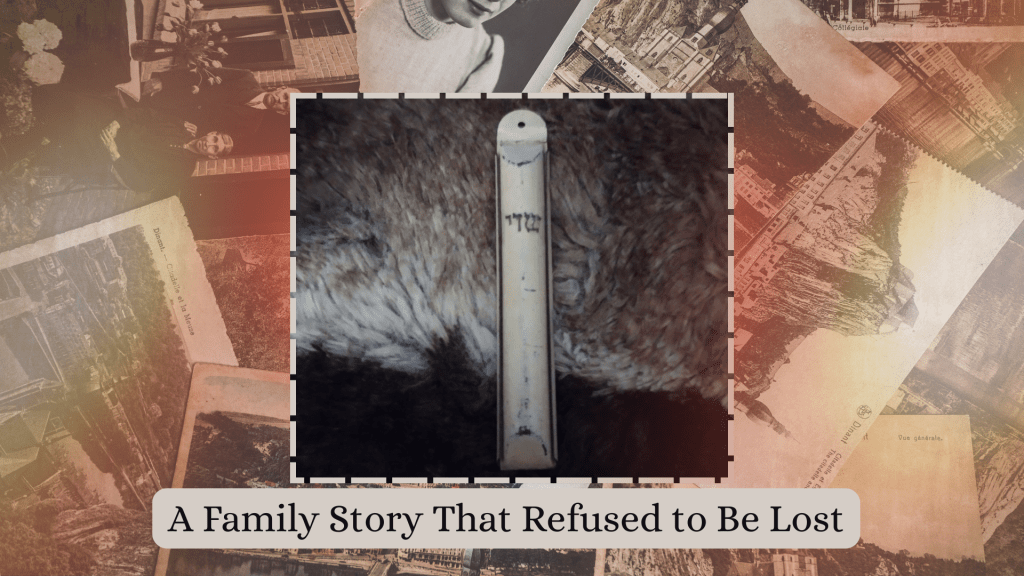

At fifty, I’ve realized that life is less a straight line and more a collection of things I’ve lost and things I’ve somehow managed to carry. Most of what I owned at twenty is long gone—surrendered to moves, divorce, and the chaos of growing up. But one tiny relic, no bigger than a finger, seems to have its own internal compass. It has spent thirty years traveling, and thankfully, it always returns to me.

The story begins when my father handed me a small tin Mezuzah—an heirloom passed down from his ancestors. His great-grandmother, on the Oreck/Oreckovsky side, used to hang it on the back of her bedroom door. I was told she kissed it each morning as she began her day. Only years later would I understand how deeply personal and meaningful that ritual was.
A Mezuzah is more than an object; it is a threshold guardian. In Jewish tradition, it marks the sacred boundary between the world and the home—a quiet witness on the doorpost that has watched generations walk in and out of their lives. The scroll inside is hand-written by a trained scribe, letter by letter, using methods passed down for thousands of years. For families who carried their faith through upheaval and migration, the Mezuzah was often the one object they protected above all else. It survived fires, relocations, pogroms, and ocean crossings. Some people even say a Mezuzah “stays with its family,” finding its way back no matter how far life scatters them. And given the journey mine has taken, I believe that, too.
For those unfamiliar, a Mezuzah contains a tiny hand-written scroll—ink on parchment—scribed with passages from Deuteronomy, including the Shema. The case is just a container; the scroll is the heart. And this one, based on its material and script, almost certainly came from villages and shtetls in the area that is now Ukraine—then part of the Russian Empire—where many Jewish families began emigrating to the United States in the late 19th century.
When my father gave it to me, I was about twenty. My life was chaotic, and I knew only one thing: this object mattered. I kept it tucked inside a small brown quilted photo album I’d loved since childhood—an album I inherited by stubborn persistence and teenage mischief. Inside that album were scraps of my growing-up years: the first play my sister and I wrote, notes from my first boyfriend, coins, poems, a marriage certificate, and letters on delicate rice paper from a Japanese pen pal. And hidden in the spine of that album, nestled like a secret, was the Mezuzah.
At twenty-three, I went through a divorce and had to uproot my life. I moved from Iowa back to Colorado and eventually entered Job Corps in Utah to create a future for my son. I couldn’t take everything with me, so I trusted my father to safeguard my box of cherished things. But life doesn’t pause for sentiment. My family experienced upheaval of their own, and in the chaos of moving, some of my belongings were taken—or thrown away—by strangers helping with the cleanup.
It was years before I learned that the album was gone. Other precious trinkets were gone too. But at the bottom of the plastic storage bin, loose and alone, was the Mezuzah. It had slipped out of the album before the album disappeared. Somehow, it survived. That moment broke me and healed me at the same time. The album was gone forever, but the relic I needed most had remained.
For nearly a decade after that first recovery, I kept the Mezuzah tucked inside a small wooden box with a handful of family keepsakes.
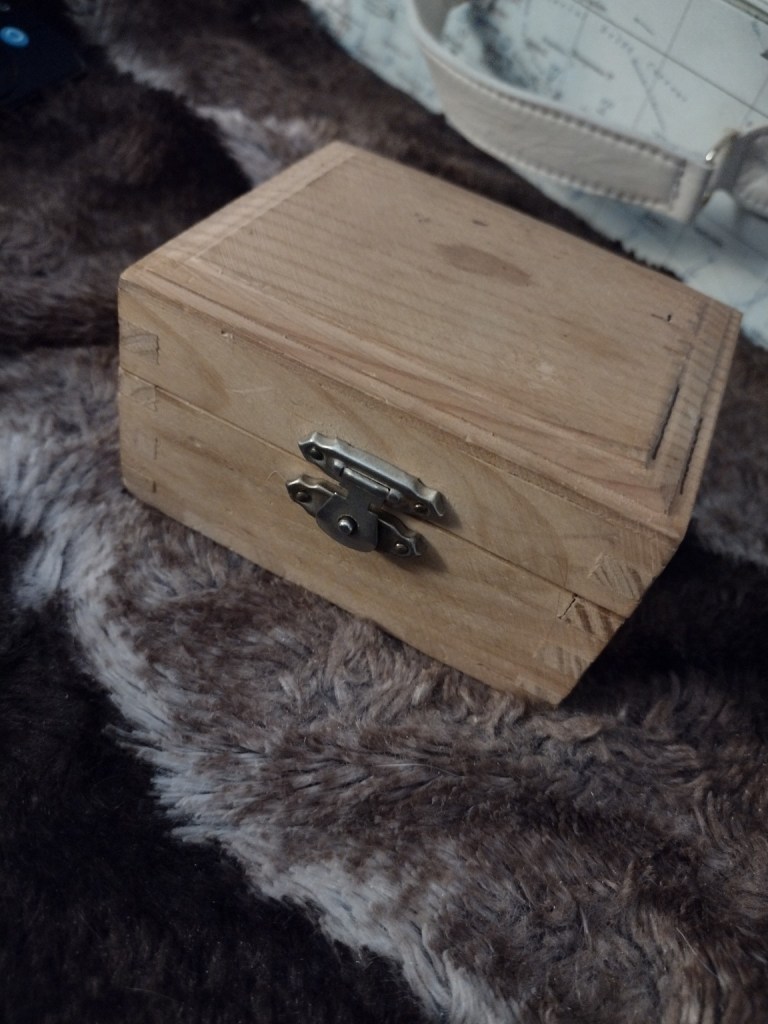
But years later, during a move from Springfield, Missouri to Arizona, we couldn’t take everything with us. A few sealed boxes were left with relatives. I thought my wooden box had made the trip—I even remember “seeing” it somewhere between addresses. But when we unpacked in Arizona, it wasn’t there. I searched for it for almost ten years. Every time we moved again, every time I cleaned a closet, every time I opened an old tote, I looked for it.
And every time, it wasn’t there.
Recently, at my father’s birthday gathering, my uncle brought me three dusty old boxes he’d been storing for more than a decade. I was excited—genuinely excited—to finally see what pieces of my past had survived. But when I got home and opened the first box, my stomach dropped. There were mouse droppings inside, and because of my immune issues, I couldn’t safely go through them myself.
So my husband did.
A few hours later, he sent me a photo:
“Is this the box you’ve been looking for?”
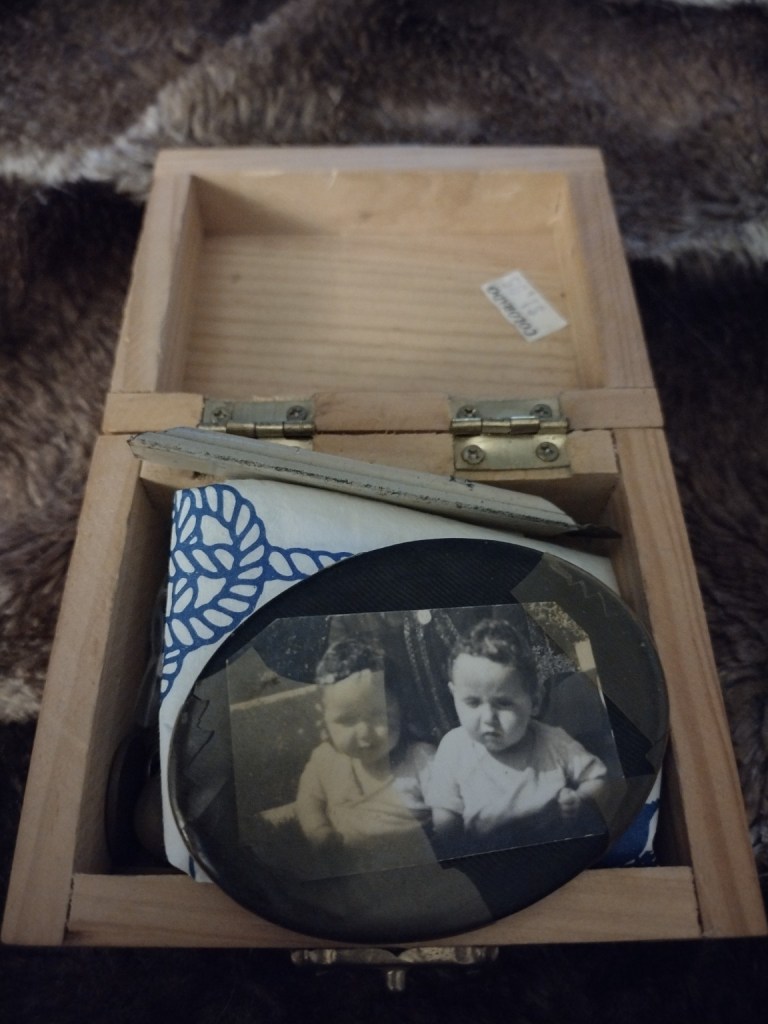
When I got home that night, my little wooden box was sitting on my desk, clean and safe. I picked it up with both hands and held it to my chest. Ten years of wondering, searching, and hoping collapsed into one breath.
Inside were the treasures I remembered:
A photo of my grandfather and his twin brother.
Coins.
Keepsakes.
Memories.
And once again—miraculously—the Mezuzah.
One thing was still missing: a 1921 Morgan silver dollar my grandfather gave to my Little Grandma Rose because it matched her birth year. I still hope it finds its way home someday too.
I told my dad I had the Mezuzah again, and his response shed light on an old memory. Years ago, his mother—my grandmother—had tried to make him ask for it back. But he wouldn’t. “It wasn’t hers to have,” he said. And he was right. It wasn’t her family’s relic. She may have demanded it, but lineage doesn’t bend to personality.
And when I said I would never have given it up, that wasn’t harsh—it was honest. My grandmother was the source of deep generational trauma in our family. This relic was not meant for her. It was meant for someone who would honor it.
It was meant for me.
I am the oldest daughter.
I am the memory keeper.
I am the Oreck in spirit, even if not in name.
Of course it belongs with me.
And holding it now—understanding what it is, where it came from, and how far it has traveled—I see the pattern more clearly than ever.
It was never lost. It was simply safe somewhere else until I was ready to carry it.
If you’re interested in the history behind my family’s journey from Ukraine to America, you can download the genealogy book The Oreckovsky Family: From Russia to America — the stories and photographs are extraordinary.
And if you want something lighter, here’s another story of a keepsake I managed to lose at a national memorial (and recover in dramatic fashion): A Splash of Adventure: My Bracelet’s Dive at Pearl Harbor.
Do you have an object like this—something that should have been lost a dozen times, but somehow always finds its way back?
I’d love to hear your story.
PS:
If you’re familiar with Mezuzahs, you might notice I didn’t include a photo of the handwritten scroll inside. In Jewish tradition, the parchment is considered sacred and isn’t typically displayed or handled casually. Out of respect for that, and for my family’s lineage, I’ve kept that part private.

YouTube Fab Five Celebration: Jennifer Welch & Angie “Pumps” Sullivan – Voices of “I’ve Had It” & IHIP News
Read More >