
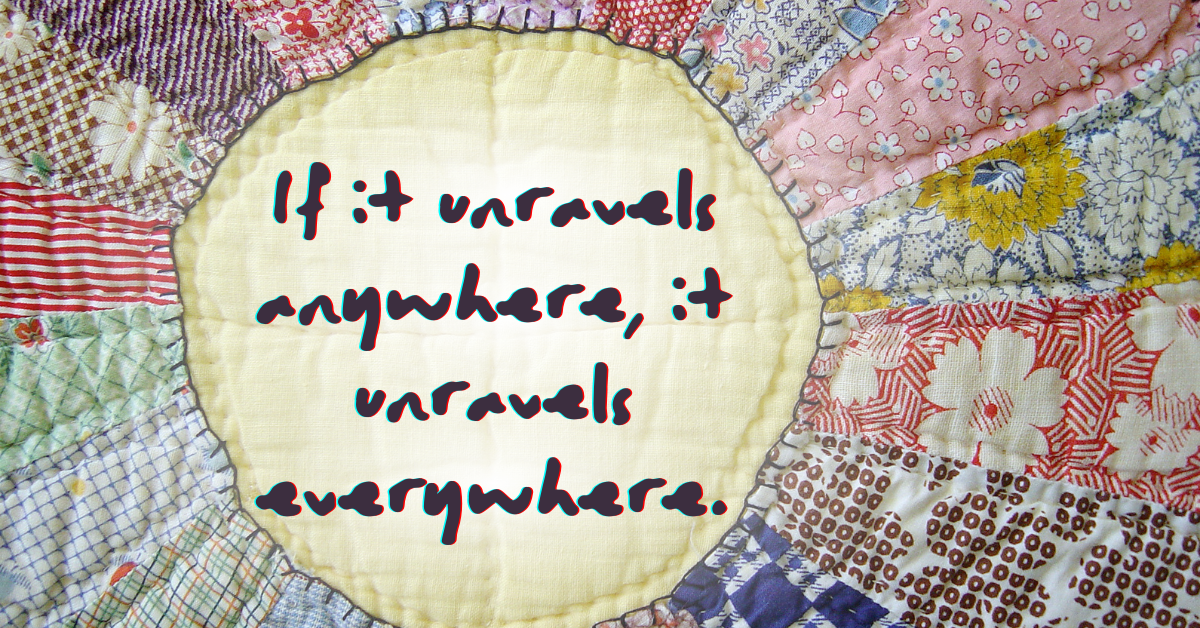


I am a quilt stitched from unlikely scraps: a little Yiddish in one ear and out the other from time to time, Cherokee pride carried deep in my chest, and a few other surprise threads woven in where the pattern runs wild. I am registered Cherokee, and the blood in my veins remembers rivers, land, and resilience. The Jewish thread is strong, too — a stubborn, questioning light that refuses to be polite about injustice. Together they make a Terra: complicated, stubborn, and unmistakably human.
Some of that Cherokee pride comes from the way my Little Grandma Rose lived. Though she was not Native herself, she married my Grandpa Rose, who was raised on the reservation. She spent time there after they married, and whatever she saw, whatever she learned, she carried into our family with reverence. She made sure her children — and her grandchildren — understood that heritage was not something to leave behind. I remember her hands, strong and work-worn, smoothing the linen placemats on the kitchen table as if she were stitching our lineage into cloth. She spoke of Grandpa’s life on the res with quiet respect, her voice steady: this matters, don’t forget it. She didn’t just say it — she lived it. And because she did, we carry it still.
Every quilt, no matter how personal, belongs to a larger pattern. Mine is sewn into the broader tapestry of America. Being American sits on top of that quilt like a bright, worn flag. We were taught the story: the greatest experiment, a melting pot where strangers become neighbors, where new names are added to old prayers. That idea still feels fierce and tender to me. It means I can be both — a woman who remembers the bite of a Yiddish phrase and the strength of Cherokee endurance — without apologizing for either. It means I can love a thousand small rituals and still insist that all people deserve dignity.
But lately, the quilt frays at the seams. Something in the room has shifted. There are people who whisper that some bodies are more worthy than others; sermons that forget mercy; politicians who trade fear for power. The same voices that claim the name of Jesus sometimes wield it like a fence, keeping out anyone who doesn’t look or pray like them. If God exists in a particular shape, I have not seen only one portrait. The idea that divinity can be contained in one skin or one creed is wrongheaded and cruel. We are all, in our messy, human ways, beloved — or we should be.
Free will — I think I’ve finally understood it. It is the freedom to choose, yes. But more than that: it is the freedom to live into who you need to be on this fragile, borrowed planet. It is the right of a Cherokee woman who carries stories, or an Ashkenazi child who throws up her hands with an “Oy vey!” at just the right moment, or anyone whose language of the sacred looks different from yours. The scales of justice are for law, not for souls. There is no scoreboard for grace.
I remember the line about entertaining angels unawares — and I smile at the image: the stranger at your table might be miraculous, not just poor. People imagine angels as neat and polished, but maybe they show up messy, ragged, hungry. Maybe they look like us.
There is grief in admitting this: I have loved this country for forty-nine years. It is my home. My family once told me we lived in the best place on earth, and for a long time that felt true. Now I sometimes wonder if that promise is unraveling — if the experiment we believed in is slipping backward, doors closing instead of opening. The fear is real, and it is not a betrayal of patriotism to say so; it is love. It is wanting the original promise to be kept.
So here I stand, a patchwork person in a patchwork nation, proud of every thread. I am proud of the stubborn questions my Jewish ancestors taught me to ask. I am proud of the quiet, steady ways my Cherokee kin showed me how to endure and care. I am proud to be American — because being American, at its best, allows me to be all of that.
But pride alone is not enough. If the experiment fails anywhere, it fails everywhere. If it collapses, it will not vanish quietly into the night — it will echo like a curse, carried through generations, stitched into the same fabric that once gave us strength. And if it survives, it will be because we remembered: no one is better, no one is lesser, no one is disposable. We must feed each other, shelter each other, open our doors — even when we are tired.
And when the angels come — ragged, poor, or weary — let us not be found turning them away at the threshold. Let us not forget the words written long ago: “As you have done it unto the least of these, you have done it unto me.” Woe to us if we forget. Blessing to us if we remember.


2 thoughts on “Slivers of Home”
A patchwork person, in a patchwork nation 😎
Exactly — stitched together, proud of every thread.